
Benefits of automated software testing: Elevate quality, speed, and savings

In today’s competitive software market, delivering high-quality applications at an accelerated pace is a fundamental requirement for business success. Manual testing, while essential for certain exploratory tasks, can no longer keep up with the demands of modern continuous integration and deployment (CI/CD) pipelines. It’s inherently slow, susceptible to human error, and often fails to provide the comprehensive coverage needed for today’s complex, interconnected systems. This is precisely where automated testing transitions from a “nice-to-have” to a core strategic imperative.
By systematically shifting from a reactive, manual bug-finding process to a proactive quality engineering strategy, teams can build far more reliable, performant, and secure applications. The primary benefits of automated software testing extend well beyond simply finding defects faster; they reshape the entire software development lifecycle, fostering a culture of quality and enabling true development velocity. This guide moves past the generic talking points to provide a detailed, actionable breakdown of these advantages.
We will explore eight critical benefits, from achieving unprecedented test coverage and reducing long-term costs to enabling faster, more reliable release cycles. For each benefit, we will detail its quantifiable impact, common implementation pitfalls, and how innovative tools that mirror real production traffic, such as GoReplay, can help you unlock its full potential. You will leave with a clear understanding of how to leverage automation not just for testing, but as a catalyst for organizational and technical excellence.
1. Increased Test Coverage and Detection of Edge Cases
One of the most significant benefits of automated software testing is the ability to achieve a breadth and depth of test coverage that is simply impractical with manual methods alone. Automation allows teams to systematically execute thousands of test cases across the entire application, validating every feature, function, and user pathway. This exhaustive approach ensures that core functionalities work as expected while also uncovering obscure, hard-to-find bugs lurking in edge cases.
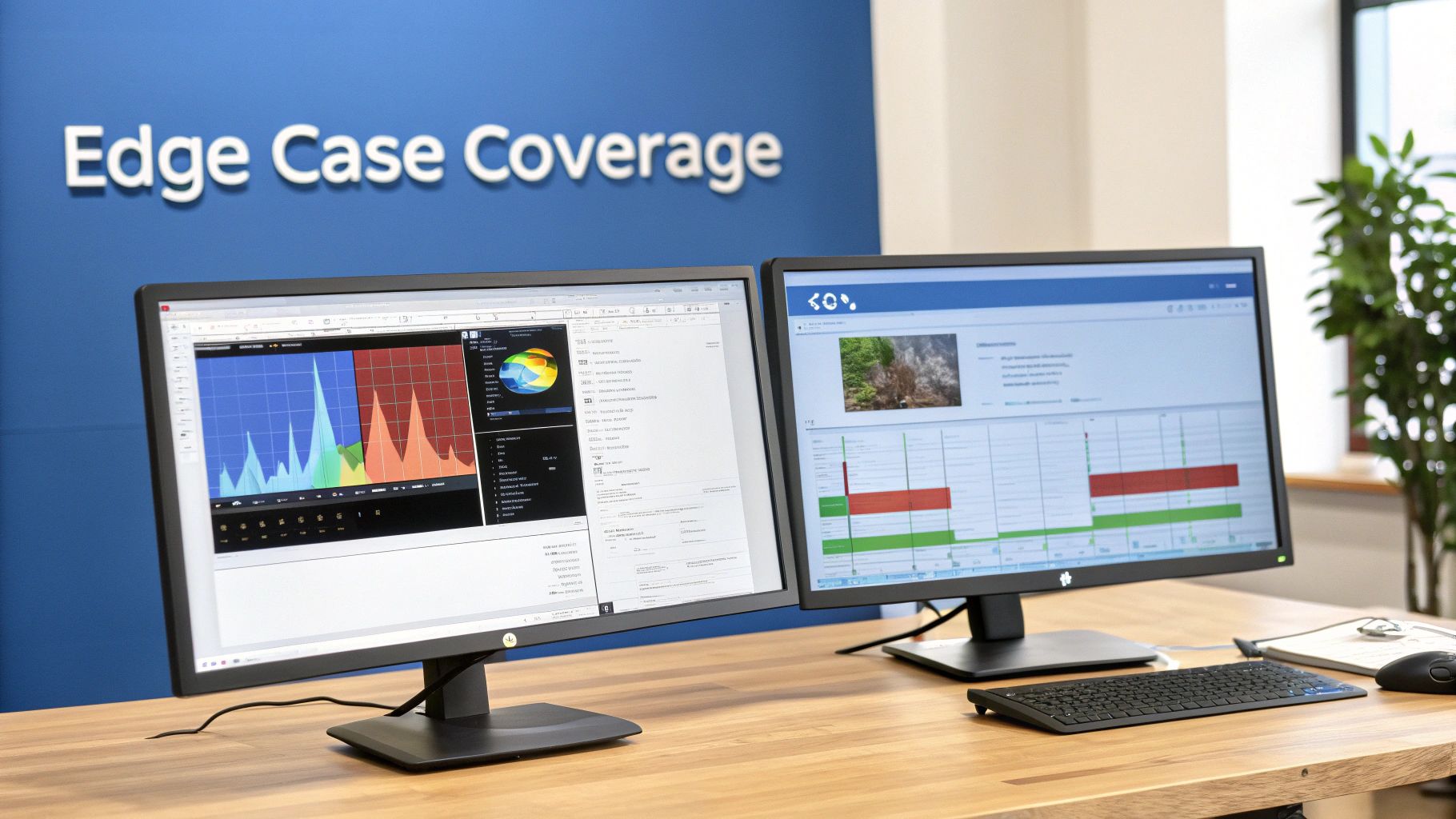
Manual testing often follows predictable “happy paths,” leaving complex user interactions and rare data combinations untested. Automated systems, especially those using production traffic replay, can simulate an immense variety of scenarios, from unusual API call sequences to fringe user permission settings that manual testers might overlook. By catching these defects early, teams prevent critical failures that could impact end-users.
Real-World Application: Testing with Production Realism
- E-commerce: A large online retailer can use a tool like GoReplay to capture and replay real checkout processes. This tests the payment flow against thousands of unique, real-world customer sessions, identifying issues with specific discount codes, shipping addresses, or payment gateway integrations that scripted tests would miss.
- Fintech: A financial services firm can use session-aware replay to validate complex, multi-step transactions. Capturing and replaying an entire user journey, from login to a multi-stage fund transfer, ensures that state is maintained correctly and no data is lost between steps.
- SaaS Platforms: A B2B SaaS company can detect edge cases in intricate user permission hierarchies by replaying traffic from clients with non-standard account setups, ensuring security models hold up under real-world complexity.
How to Implement for Maximum Coverage
To effectively increase test coverage, start by identifying the most critical and high-traffic user paths in your application. Use analytics dashboards to pinpoint these areas and prioritize them for automation. Implement session-aware replay tools to capture entire user journeys, not just isolated requests.
Key Insight: The goal isn’t just to run more tests, but to run smarter tests that mirror real-world user behavior. Replaying production traffic is the most direct way to validate how your system performs under authentic conditions.
Finally, combine your robust automation suite with periodic manual reviews of critical paths to get the best of both worlds. This layered approach is a cornerstone of modern quality assurance, a concept explored further in our guide to unleashing the power of automated testing. By systematically increasing test coverage, you directly improve application reliability and user trust.
2. Significant Cost Reduction Through Efficiency Gains
One of the most compelling benefits of automated software testing is its direct impact on the bottom line. Automation significantly reduces the total cost of quality assurance by minimizing repetitive manual labor, catching bugs before they reach production, and freeing up engineering resources. By automating regression suites and routine checks, organizations can shrink the time and personnel required for each release cycle, leading to substantial long-term savings.
This efficiency gain allows teams to reallocate valuable resources from tedious, time-consuming manual testing to more strategic initiatives like exploratory testing, security analysis, and improving the automation framework itself. Furthermore, preventing production bugs translates directly to lower operational costs by reducing downtime, minimizing the need for emergency hotfixes, and avoiding potential revenue loss or damage to brand reputation caused by system failures.
Real-World Application: Driving Down QA Costs
- Enterprise Scale: A company like Netflix utilizes extensive automation to manage its complex microservices architecture. By automating regression testing, they can deploy changes rapidly and confidently without incurring the massive cost of a manual QA team large enough to cover their entire service ecosystem.
- High-Velocity DevOps: Google’s engineering culture relies heavily on automated testing to handle thousands of code commits daily. This level of automation is the only financially viable way to maintain quality at such a massive scale, preventing a bottleneck that would otherwise cripple development velocity.
- Lean Startups: A startup can leverage open-source tools to implement enterprise-grade testing without a large budget. Using a tool’s free tier for production traffic replay, they can achieve high-fidelity testing and prevent costly production incidents that could be existential for a young company.
How to Implement for Maximum ROI
To maximize cost savings, start by calculating the potential return on investment (ROI). Compare the hours your team currently spends on manual regression testing against the estimated time to build and maintain an automation suite. Prioritize automating the most stable, critical, and frequently tested features to see the quickest returns.
Key Insight: The true cost of a bug increases exponentially the later it is found in the development lifecycle. Automated testing shifts defect detection left, drastically cutting the cost of remediation.
Track key metrics like the reduction in production incidents and the decrease in manual testing hours per release to quantify the savings. Investing in proper team training on automation tools and best practices from day one ensures you build an efficient, scalable, and cost-effective testing process. This proactive approach is a cornerstone of achieving sustainable quality engineering.
3. Faster Release Cycles and Continuous Deployment Enablement
One of the most transformative benefits of automated software testing is its ability to drastically accelerate the software development lifecycle. By integrating automated tests into a continuous integration and continuous deployment (CI/CD) pipeline, teams can deploy code changes with both high frequency and confidence. This process allows for comprehensive tests to run instantly on every code commit, providing immediate feedback and enabling rapid iteration.

Manual testing introduces significant bottlenecks, turning the release process into a slow, multi-day affair. Automation removes this delay, transforming development from a linear, waterfall-style process into a dynamic, agile loop. This acceleration is crucial for modern businesses, allowing them to respond swiftly to market demands, user feedback, and competitive pressures without sacrificing quality.
Real-World Application: High-Velocity Deployments
- E-commerce & Tech Giants: Companies like Amazon famously deploy code thousands of times a day. This is only possible through a deeply integrated and exhaustive automated testing suite that validates every change before it reaches production.
- Streaming & SaaS: Spotify manages thousands of microservices by leveraging automated testing to support multiple daily releases. This allows them to innovate on features and fix bugs without coordinating massive, monolithic deployments.
- Ride-Sharing: To ensure new features do not disrupt their complex logistics systems, companies like Uber use traffic replay tools to validate changes in a staging environment that mirrors real production traffic, providing a final quality gate before deployment.
How to Implement for Maximum Velocity
Start by integrating a small suite of critical “smoke tests” into your CI/CD pipeline that run on every commit. This creates a fail-fast mechanism that gives developers immediate feedback. Gradually expand test coverage to include regression, integration, and performance tests that run at different stages of the pipeline.
Key Insight: The goal of automation in CI/CD is not just to find bugs, but to build a high-trust, low-friction path to production. Replaying production traffic in a staging environment is a powerful way to validate changes against real-world scenarios before release.
Finally, establish clear success criteria for your automated tests to enable automatic promotion of code through the pipeline. This strategy, central to DevOps, empowers teams to deliver value to users faster and more reliably. By embedding quality checks directly into the development workflow, you make speed and stability allies, not adversaries.
4. Enhanced Reliability and Reduced Production Incidents
One of the most critical benefits of automated software testing is its role as a quality gate, preventing defects from ever reaching production. By systematically testing applications against realistic traffic patterns and known failure points, organizations can dramatically reduce the frequency and severity of production incidents. This proactive approach improves system uptime, enhances user satisfaction, and safeguards brand reputation by making reliability a measurable and predictable outcome.
Manual testing can catch predictable bugs, but it often misses the complex, intermittent issues that cause major outages. Automated tests, especially those leveraging production traffic, validate how the system behaves under authentic load and usage patterns. This ensures that new code deployments don’t introduce subtle regressions or performance bottlenecks that could destabilize the entire application, turning quality assurance into a direct driver of operational stability.
Real-World Application: Proactive Incident Prevention
- Financial Services: A payment processor like Square can use transaction replay testing to validate new gateway integrations. By replaying millions of real, anonymized past transactions against the new code, they can detect subtle processing errors or latency spikes before a single customer is affected.
- Social Media: A platform like LinkedIn can implement automated reliability tests that simulate high-traffic scenarios, such as a viral post. This prevents cascading failures and ensures the platform remains responsive during peak usage, preventing millions of failed user sessions.
- Healthcare: A health records provider can use automated testing to ensure HIPAA-compliant system reliability. Replaying production scenarios validates that data integrity and access controls remain secure after every update, preventing critical data breaches or service outages.
How to Implement for Maximum Reliability
To effectively reduce production incidents, start by creating automated tests for every previously discovered bug; this is a core principle of regression prevention. Use tools like GoReplay to capture and replay real production traffic in your staging environment, which provides the most accurate pre-release validation possible.
Key Insight: True reliability isn’t just about fixing bugs; it’s about building a system that prevents them from recurring. Automating tests based on past incidents and real traffic transforms your testing suite into an institutional memory of what can go wrong.
Establish clear Service Level Objectives (SLOs) for your application and use automated performance and load tests to continuously validate your compliance. By integrating these practices, your testing process becomes a powerful engine for building and maintaining a highly reliable product that users can trust.
5. Improved Test Data Management and Realistic Testing Scenarios
A core challenge in quality assurance is sourcing test data that accurately reflects real-world usage. Automated testing, particularly when paired with traffic capture technologies, revolutionizes this process by enabling teams to create authentic and dynamic testing scenarios. Instead of relying on synthetic, often simplistic data, organizations can capture actual user sessions from production, creating a high-fidelity environment that validates system behavior under genuine conditions.
This approach moves beyond scripted “happy paths” to test complex, multi-step user workflows exactly as they occur. By capturing and replaying production traffic, teams can validate edge cases, intricate transaction sequences, and unusual user inputs that are nearly impossible to invent manually. Crucially, this can be done while maintaining data privacy through robust masking and anonymization, ensuring compliance without sacrificing test realism.
Real-World Application: Validating with Authentic Data
- Banking: A financial institution can use GoReplay to capture and replay anonymized transaction flows, testing its payment processing systems with realistic patterns of deposits, transfers, and fraud alerts.
- Healthcare: A health-tech platform can safely test new features by replaying anonymized patient interaction flows, ensuring that updates to electronic health record systems do not disrupt critical clinical workflows.
- E-commerce: An online retailer can test its checkout process against thousands of real, captured purchase patterns, validating everything from complex discount code combinations to varied international shipping calculations.
How to Implement for Maximum Realism
The key to leveraging this benefit of automated software testing is a strong data governance framework. Start by implementing strict data masking policies to remove all personally identifiable information (PII) before traffic is used in testing environments. Tools like GoReplay offer built-in features to facilitate this.
Key Insight: The quality of your tests is directly tied to the quality of your test data. Using sanitized production traffic is the most effective way to ensure your tests are validating the scenarios your users actually encounter.
Store captured traffic securely with restricted access controls and conduct regular audits to ensure compliance with privacy regulations like GDPR and CCPA. Documenting all data handling procedures is critical. This disciplined approach is fundamental to mastering test data management best practices and unlocking truly realistic testing scenarios.
6. Better Visibility Into Application Performance and Behavior
Beyond simply finding functional bugs, automated testing provides deep, quantifiable insights into how applications perform under various conditions. Automation excels at revealing performance bottlenecks, memory leaks, and gradual degradation that manual testing can rarely detect. Through detailed metrics and analytics, teams gain a transparent, data-driven view of system behavior that informs optimization priorities and preempts user-facing performance issues.
Manual testing is subjective and cannot reliably measure response times, CPU usage, or database query efficiency at scale. Automated performance and load testing tools can simulate thousands of concurrent users and capture precise performance data for every transaction. This allows teams to understand not just if a feature works, but how well it works under real-world stress, which is one of the most critical benefits of automated software testing.
Real-World Application: Performance Optimization at Scale
- Social Media: A platform like Twitter can use automated load testing to simulate massive user spikes during major global events. This helps them identify scalability limits and infrastructure bottlenecks long before they impact the live service.
- Fintech: PayPal can use performance analytics from automated tests to optimize transaction processing times. By replaying production traffic, they can identify slow API endpoints or inefficient database queries that add milliseconds to each transaction, improving the user experience at scale.
- Mobile Apps: Mobile developers can use GoReplay to capture and replay API traffic from their apps. This helps identify slow-loading screens or features by pinpointing underperforming backend APIs, allowing for targeted optimization.
How to Implement for Maximum Visibility
Start by defining clear performance baselines and thresholds for your critical user journeys. What is an acceptable response time for your login API or product search? Use a tool like GoReplay to replay production traffic against your staging environment, which provides a realistic performance benchmark.
Key Insight: True performance visibility comes from testing with realistic load patterns, not just high volume. Replaying actual production traffic patterns ensures you are optimizing for how users truly interact with your system.
Continuously monitor these performance metrics across releases, implementing automated alerts for any significant degradation. Correlating performance regressions directly with code changes allows developers to quickly pinpoint and resolve the root cause. This proactive approach to performance management turns testing from a simple bug hunt into a strategic optimization tool.
7. Increased Developer Productivity and Faster Feedback Loops
One of the most transformative benefits of automated software testing is its ability to create rapid, continuous feedback loops for developers. Automation provides immediate validation of code changes, shifting quality checks from a delayed, end-of-cycle event to an integrated part of the development process. Instead of waiting hours or days for manual QA results, developers receive instant confirmation that their new code works as intended and hasn’t introduced regressions.

This accelerated feedback cycle is crucial for maintaining momentum and focus. When a developer can run tests and get results in minutes, they can fix bugs while the context is still fresh in their mind, drastically reducing the mental overhead of context-switching. This empowers developers to take greater ownership of code quality, fostering a proactive culture where testing is a shared responsibility, not a separate team’s bottleneck.
Real-World Application: Empowering Developers with Instant Validation
- Large Tech Companies: At organizations like Google and Facebook, developers rely on massive, internal CI/CD systems that provide near-instant test feedback. This real-time validation is essential for their rapid development and deployment cycles, allowing thousands of engineers to merge code confidently multiple times a day.
- DevOps Platforms: GitHub’s own development process heavily utilizes automated testing within its CI/CD tool, GitHub Actions. Developers run comprehensive test suites on every pull request, ensuring that code is validated against all requirements before it can be merged into the main branch.
- Open-Source Projects: Contributors to open-source projects can use tools that replicate production environments to test their changes against realistic conditions. This gives them confidence that their contributions will work correctly in the live system, lowering the barrier for community involvement.
How to Implement for Maximum Productivity
To accelerate feedback loops, integrate automated tests directly into the developer workflow. Start by setting up pre-commit hooks that run essential unit and integration tests before code is even submitted to the repository. Ensure your primary test suite executes quickly, ideally in under 10 minutes, to avoid disrupting developer flow.
Key Insight: The speed of the feedback loop is directly proportional to developer productivity. When tests are fast and reliable, they become a helpful tool rather than a frustrating obstacle.
Finally, make test results easy to understand with clear, actionable error messages. When a test fails, the developer should immediately know why and where to look. By making testing an accessible and immediate part of the coding process, you not only improve code quality but also significantly boost the efficiency and morale of your entire engineering team.
8. Consistent Quality Standards and Reduced Manual Testing Errors
One of the foundational benefits of automated software testing is the establishment of unwavering quality standards by eliminating the variability and fatigue inherent in manual processes. Humans, no matter how diligent, can make mistakes, forget steps, or interpret requirements differently on separate occasions. Automation executes the exact same steps and validations with perfect fidelity every single time, ensuring that quality criteria are applied consistently across every test run, build, and environment.
This programmatic consistency transforms quality from a subjective goal into a measurable and predictable metric. By removing human error from the execution loop, organizations can establish a reliable quality baseline. Any deviation from this baseline is a genuine regression, not a potential testing anomaly, making it easier to trust results and make confident release decisions.
Real-World Application: Enforcing Quality at Scale
- Operating Systems: A company like Microsoft runs billions of automated test combinations to ensure Windows quality. This consistent approach is crucial for validating stability across an immense variety of hardware and software configurations, something impossible to achieve consistently with manual testing.
- Enterprise Software: Major enterprise software vendors rely on consistent automation to achieve and maintain stringent certifications like ISO compliance. Automated tests provide the auditable, repeatable proof that their systems consistently meet required quality and security standards.
- SaaS Platforms: A platform like Salesforce uses automated testing to consistently validate its core stability against a backdrop of countless customer customizations. This ensures that new platform updates do not break existing bespoke workflows, maintaining trust across its entire user base.
How to Implement for Maximum Consistency
To leverage automation for consistent quality, begin by meticulously documenting your test criteria and success conditions. Use version control systems like Git for all test scripts and their associated test data to track changes and maintain a history of your quality standards.
Key Insight: True consistency is achieved when the test stimulus is as repeatable as the test execution. Using tools that replay identical, real-world traffic patterns ensures that you are testing against the same conditions every time, providing a true apples-to-apples comparison between builds.
Establish clear, binary pass/fail criteria before test execution begins to remove any ambiguity from the results. Tools that replay production traffic, like GoReplay, are instrumental here, as they can consistently subject your application to the exact same sequence of user requests, ensuring your quality baseline is tested against realistic and repeatable scenarios. This systematic enforcement of standards is a key pillar of a mature QA strategy.
Automated Testing: 8-Point Benefits Comparison
| Benefit | 🔄 Implementation complexity | ⚡ Resource requirements | 📊 Expected outcomes | 💡 Ideal use cases | ⭐ Key advantages |
|---|---|---|---|---|---|
| Increased Test Coverage and Detection of Edge Cases | High — significant initial setup and scenario design | Moderate–High: tooling, capture infrastructure, skilled engineers | Detects intermittent/edge bugs; higher overall reliability | Complex user flows (e‑commerce checkout, finance, streaming) | Catches edge cases missed by manual tests; session-aware replay |
| Significant Cost Reduction Through Efficiency Gains | Medium — upfront tool/infrastructure investment and training | Lower long-term QA labor; upfront licensing/infra or open-source adoption | Reduced QA OPEX, fewer production incidents, faster time‑to‑value | Organizations seeking TCO reduction; startups to enterprises | Lowers TCO over time; scalable automation; open-source free tier |
| Faster Release Cycles and Continuous Deployment Enablement | High — requires CI/CD integration and cultural change | CI/CD pipelines, staging environments, orchestration tooling | Increased deployment frequency; faster time‑to‑market; rapid feedback | Teams adopting CI/CD, microservices, rapid-release roadmaps | Enables multiple daily releases; automated rollbacks; safe staging via replay |
| Enhanced Reliability and Reduced Production Incidents | Medium–High — ongoing maintenance of tests and monitoring | Monitoring/analytics, traffic capture, test upkeep | Fewer and less severe incidents; improved uptime and user trust | Mission‑critical systems (fintech, healthcare, large platforms) | Early detection of regressions; predictive issue ID; uptime protection |
| Improved Test Data Management and Realistic Testing Scenarios | Medium — data‑masking and privacy controls needed | Storage for captured traffic, masking tools, access controls | Realistic test results; better validity of tests; compliance support | Banking, healthcare, e‑commerce needing authentic data scenarios | Uses real traffic with data masking for GDPR/PCI compliance |
| Better Visibility Into Application Performance and Behavior | Medium — observability and analytics setup; skill to interpret | Metrics collection, dashboards, possible dedicated test envs | Early bottleneck detection; data‑driven optimization decisions | Performance‑sensitive systems and scaling platforms | Detailed transaction‑level insights and trend analysis |
| Increased Developer Productivity and Faster Feedback Loops | Low–Medium — integrate tests into dev workflow and CI | Fast test suites, IDE/CI integration, developer training | Faster debugging, reduced context switching, higher code quality | Dev-centric teams, high‑velocity feature development | Immediate feedback in workflow; reduces dependency on QA |
| Consistent Quality Standards and Reduced Manual Testing Errors | Medium — precise test specs and maintenance discipline | Versioned test suites, logging, repeatable environments | Predictable, measurable quality; fewer human errors | Organizations needing compliance, large release cadence | Deterministic replay and consistent pass/fail criteria for audits |
Moving Forward: Integrating Automation Into Your Quality Strategy
Throughout this exploration, we’ve unpacked the multifaceted benefits of automated software testing, moving beyond surface-level advantages to reveal a fundamental shift in how modern software is built and delivered. We have seen how a strategic approach to automation is not merely a tactical choice but a strategic imperative for any organization aiming for market leadership, operational excellence, and customer satisfaction. The journey from manual, error-prone testing to a streamlined, automated quality assurance pipeline is transformative, touching every facet of the software development lifecycle.
The core advantages we’ve discussed-from dramatic increases in test coverage and the ability to detect elusive edge cases to significant long-term cost reductions-form the bedrock of a robust quality strategy. Automation is the engine that powers faster, more reliable release cycles, making concepts like Continuous Integration and Continuous Deployment (CI/CD) a practical reality rather than a distant goal. By establishing consistent quality standards and reducing the human error inherent in repetitive manual checks, you build a more resilient and predictable development process.
Synthesizing the Impact: From Theory to Practice
The true power of automation is realized when these individual benefits converge. Faster feedback loops don’t just help developers fix bugs quicker; they foster a culture of ownership and quality, empowering engineers to build better code from the start. Enhanced reliability isn’t just about reducing production incidents; it’s about protecting brand reputation, ensuring customer trust, and freeing your team from the reactive cycle of firefighting to focus on innovation and value creation.
Key Takeaway: The ultimate goal of test automation is not just to find bugs faster, but to create a high-velocity, high-confidence development ecosystem where quality is an intrinsic part of the process, not an afterthought.
Achieving this requires a strategic mindset. It’s not about automating everything, but about automating the right things. This means prioritizing tests based on business risk, user impact, and frequency of execution. It involves a commitment to maintaining your test suite as diligently as you maintain your production code and selecting tools that address your most pressing challenges.
Your Actionable Roadmap to Automation Success
Embracing the benefits of automated software testing is a journey, not a destination. To move from theory to tangible results, consider these immediate next steps:
- Identify Your Pilot Project: Don’t try to boil the ocean. Select a single, high-value user journey or a critical API endpoint. Focus on a bounded area where you can demonstrate a clear win, build momentum, and learn valuable lessons.
- Focus on Realism: The greatest weakness of traditional testing is the gap between the test environment and production reality. Prioritize strategies that bridge this divide. Explore how you can leverage production-like data or, even better, real user traffic to validate changes with unparalleled confidence.
- Evaluate Modern Tooling: The right tools can make all the difference. Look for solutions that go beyond simple script execution. Consider platforms like GoReplay that enable sophisticated techniques like traffic shadowing and replay, allowing you to test new code with the full complexity and unpredictability of your live production environment, safely and silently.
- Foster a Quality Culture: Make quality assurance a shared responsibility. Equip developers with the tools and training to write and run their own tests. Integrate test execution directly into your CI/CD pipeline so that feedback is immediate, automated, and unavoidable.
By adopting this incremental and strategic approach, you transition from a team that tests for quality to a team that builds in quality. This is the definitive shift that separates market leaders from the rest. The path forward is clear: integrate intelligent automation into the very fabric of your development workflow, and you will unlock a new level of speed, reliability, and innovation.
Ready to experience the most powerful benefits of automated software testing by validating your changes against real production traffic? Discover how GoReplay can help you mirror your production environment, run load tests with authentic user behavior, and eliminate deployment risks. Explore the open-source tooling and enterprise solutions at GoReplay to start building more resilient systems today.