
The Real Impact of Automated Regression Tests

Automated regression tests are changing how software teams approach quality. This isn’t just about automating repetitive tasks; it’s about shifting workflows and enabling a more proactive approach to bug detection. Instead of reacting to late-stage issues, automated regression tests help teams find and fix regressions quickly, often before they reach the staging environment.
Preventing Bugs From Reaching Production
One of the biggest benefits of automated regression testing is its ability to catch bugs early, preventing them from reaching production. Manual testing, while important, can be prone to human error and may not fully cover the complex interactions within modern software. Automated testing, on the other hand, executes tests with precision and consistency, ensuring thorough checks against existing functionality with every code change. This significantly reduces production defects, saving time, resources, and potential damage to reputation.
The Shift Towards Automation
This increased reliability is driving the widespread adoption of automated testing methods for regressions. By 2025, almost half (46%) of testing teams reported automating at least half of their manual testing efforts. More precisely, 26% automated up to half of their manual tests, and another 20% automated at least 75%. This shows growing confidence in automated technologies for handling complex testing tasks. For more statistics, see: Test Automation Statistics. This trend highlights the increasing importance of automated regression testing for maintaining software quality.
The Benefits of Faster Release Cycles
Automated regression tests also enable faster release cycles. Automating these repetitive checks allows teams to verify the impact of code changes much more frequently, sometimes even multiple times per day. This aligns with Agile and Continuous Delivery practices, where rapid iteration and frequent deployments are crucial for staying competitive. This allows developers to deliver value to users faster and respond to changing market needs with greater agility. This shift in testing also fosters a more proactive development culture, prioritizing quality at every stage.
Measurable Benefits That Justify Automation Investment
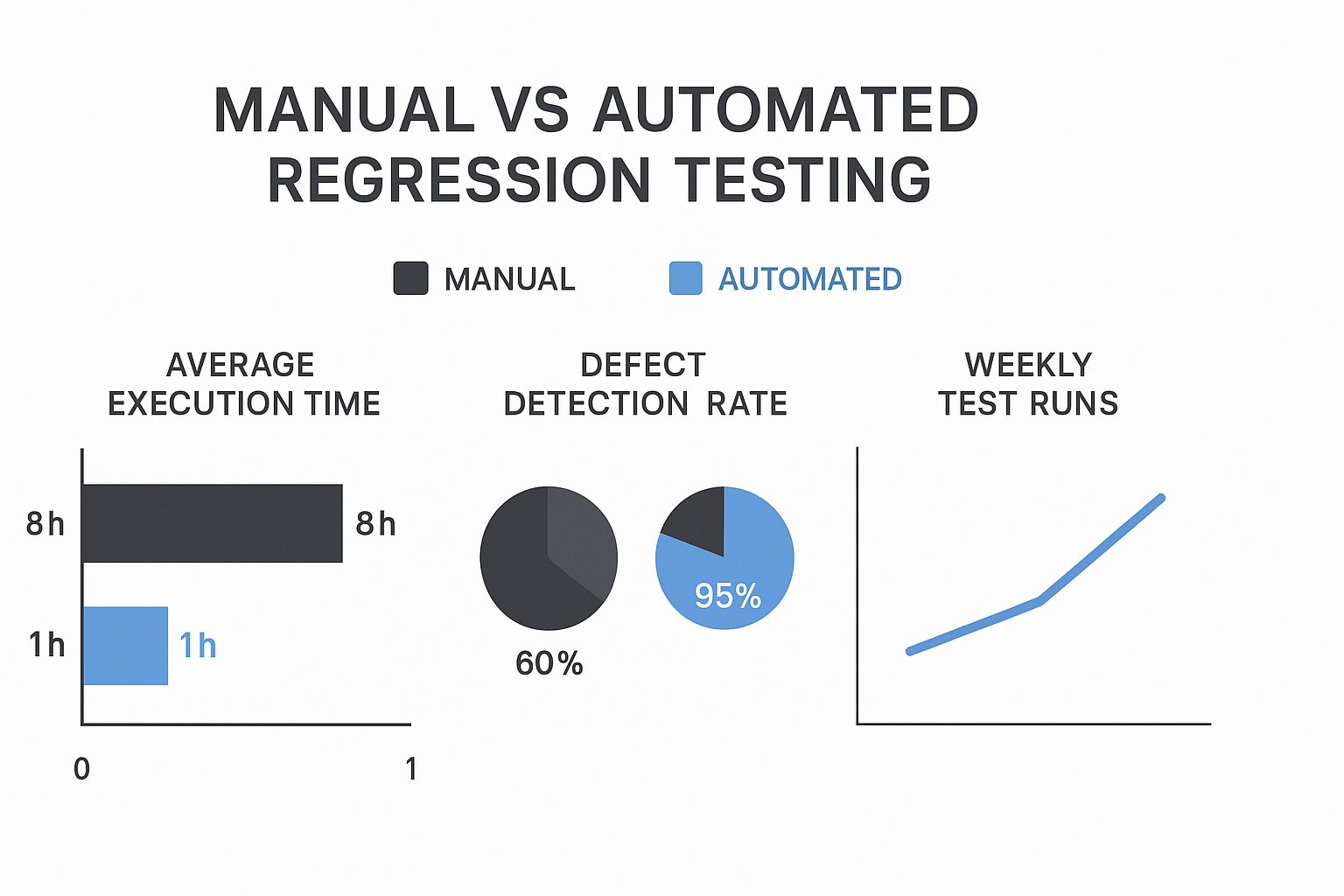
The infographic above illustrates the advantages of automated regression testing. Comparing manual and automated approaches across key metrics like execution time, defect detection, and weekly test runs reveals significant improvements. Automated tests slash execution time from 8 hours down to 1 hour. They also boost the defect detection rate from 60% to an impressive 95%. Finally, automation enables five times more weekly test runs. This increased efficiency results in faster feedback and higher software quality.
Reduced Regression Cycle Time
One of the most significant benefits of automated regression tests is the substantial reduction in testing time. This efficiency translates directly into faster release cycles, empowering organizations to deliver value to customers more frequently. For instance, tests that previously required days of manual effort can now be completed in mere hours. This speed allows teams to respond rapidly to market demands, a crucial factor for staying competitive.
Improved Defect Detection Rate
Automated tests execute with more precision and consistency than manual tests, resulting in a much higher defect detection rate. This means fewer bugs make it into production, increasing customer satisfaction and reducing the costs associated with fixing issues after release. Early detection also simplifies the debugging process and lowers the cost of fixes, as problems are addressed before they impact other parts of the codebase. You might be interested in: Game-Changing Benefits of Automated Testing.
Increased Test Coverage and Frequency
Automated regression tests allow teams to run tests more frequently and explore a wider range of scenarios. This comprehensive test coverage increases confidence in the software’s quality. The increased testing frequency also minimizes the risk of introducing new bugs during development, improving overall reliability. The ability to run tests overnight or during off-peak hours further optimizes development workflows.
ROI on Automation Investments
Investment in automated testing tools like Selenium has grown substantially, mirroring the increased adoption of automated regression testing. Global spending on these tools saw a nearly 30% increase in the year leading up to 2025. Experts advise automating 60-70% of regression tests to maximize benefits. This investment is closely tied to the rise of Continuous Integration/Continuous Deployment (CI/CD) practices. Approximately 70% of development teams have integrated automated tests into their CI/CD pipelines. For more detailed statistics, see Test Automation Statistics and Trends. Automated regression testing enables organizations to maintain the rapid release cycles demanded by today’s market while minimizing the risk of post-release issues.
The table below presents a comparison of key performance indicators before and after implementing automated regression testing, demonstrating the return on investment (ROI) that automation provides.
ROI Metrics for Automated Regression Testing
A comparison of key performance indicators before and after implementing automated regression tests
| Metric | Manual Regression Testing | Automated Regression Testing | Typical Improvement |
|---|---|---|---|
| Average Execution Time | 8 hours | 1 hour | 7 hours (87.5%) |
| Defect Detection Rate | 60% | 95% | 35% |
| Weekly Test Runs | 1 | 5 | 4 (400%) |
This table clearly shows how automated regression testing provides significant improvements in efficiency and effectiveness. The substantial decrease in execution time, coupled with the increase in defect detection and testing frequency, translates to a substantial return on investment.
Finding the Sweet Spot Between Manual and Automated Tests

While automated regression tests offer clear advantages, a completely automated strategy isn’t always ideal. Effective testing hinges on finding the right mix of manual and automated approaches. This means figuring out which test cases offer the best return on investment when automated and which ones benefit from human oversight. This balanced approach allows teams to utilize the strengths of both methods, leading to better test coverage and quicker releases.
Identifying Ideal Candidates for Automation
Some tests are simply better suited for automation. Repetitive tests, especially in regression testing, are prime examples. Automating these tests not only saves time and resources, but also boosts accuracy by removing human error. Data-driven tests, where the same steps are repeated with different data, also greatly benefit from automation. Tools like GoReplay are particularly useful here, simulating real user traffic with various data sets.
The Enduring Value of Manual Testing
This doesn’t mean manual testing is obsolete. Exploratory testing, where testers explore the software’s functionality without pre-written scripts, depends heavily on human intuition and experience. This type of testing is crucial for uncovering unexpected problems and evaluating usability. Tests requiring subjective judgment, such as those focusing on user experience, are also best handled by human testers. This remains true even with the rise of automation, with up to 82% of testers still regularly performing manual tests.
This highlights the critical importance of finding the right balance. About 45% of testers use automated regression tests to boost efficiency. This strategic approach, using automation to support manual efforts, is gaining popularity. You can explore more about test automation statistics for 2025 here.
Building a Balanced Testing Strategy
Achieving the right balance demands a strategic plan. Teams should prioritize automating tests that are:
- High-Frequency: Tests run frequently benefit the most from automation, maximizing time saved.
- Repetitive: Automating repetitive tasks lets testers focus on more challenging and creative work.
- Data-Driven: Automated tests excel at managing various data inputs and changes.
- Objective: Tests with clear pass/fail criteria are easily automated, minimizing human input.
By focusing on automating these types of tests, teams can create a robust testing strategy that combines the speed and efficiency of automated tests with the critical thinking and flexibility of manual testing. This combined method allows for better test coverage while lowering costs and boosting the impact of testing efforts. This comprehensive approach to quality assurance truly helps teams deliver high-quality software quickly.
Selecting Automation Tools That Actually Deliver Results
Picking the right automation tools for regression testing can be daunting. With so many options, it’s hard to see past the marketing and figure out what’s truly valuable. The key is identifying features that deliver real, lasting benefits for your automated regression tests. This means focusing on practical aspects like maintainability, the learning curve for your team, integration options, and the available support.
Key Features for Long-Term Success
When evaluating regression testing tools, prioritize features that build a sustainable and efficient testing process. A short learning curve gets your team up to speed quickly, while solid reporting gives you insights into test results. Seamless CI/CD pipeline integration streamlines workflows, and a strong community offers invaluable troubleshooting and best practices. You might be interested in: Best Test Automation Tools for Every Team Size and Need.
-
Ease of Maintenance: Tests should be adaptable as your application changes. Choose tools that minimize the work needed to update tests as your code evolves.
-
Learning Curve: A steep learning curve can slow down your testing process. Pick a tool that matches your team’s current skills and technical knowledge.
-
Integration Capabilities: Smooth integration with your CI/CD pipeline ensures automated regression tests run as part of your development process.
-
Community Support: An active community offers valuable resources, troubleshooting help, and opportunities to share best practices.
To help you compare popular tools, we’ve compiled the following table:
Introduction to Comparison Table: The following table provides a quick overview of several leading automated regression testing tools, highlighting their key features, supported programming languages, learning curves, CI/CD integration capabilities, reporting features, and ideal use cases.
| Tool/Framework | Programming Languages | Learning Curve | CI/CD Integration | Reporting Features | Best For |
|---|---|---|---|---|---|
| Selenium | Java, Python, C#, Ruby, JavaScript, etc. | Moderate | Extensive | Built-in and third-party integrations | Web UI testing |
| Cypress | JavaScript | Relatively Easy | Excellent | Built-in detailed reports | Web UI testing, especially for JavaScript frameworks |
| Appium | Java, Python, C#, Ruby, JavaScript, etc. | Moderate | Good | Varies depending on the testing framework used | Mobile app testing |
| Playwright | JavaScript, TypeScript, Python, Java, .NET | Relatively Easy | Excellent | Built-in HTML reports | Cross-browser web UI testing |
| Robot Framework | Python | Easy | Good | Built-in reports and XML logs | Acceptance testing, keyword-driven testing |
Conclusion of Comparison Table: As you can see, different tools excel in different areas. Consider your team’s technical skills and project needs when making a selection. For example, if your team primarily uses JavaScript, Cypress or Playwright might be good choices. If you need to test mobile apps, Appium is a strong contender.
Evaluating Established Frameworks and Emerging AI-Powered Solutions
Both established frameworks like Selenium and newer AI-powered solutions have their place in automated regression testing. Established frameworks often offer a stable foundation and extensive community support. Newer AI-powered options may include features like self-healing tests and automated test generation. Consider the pros and cons of each type relative to your team and project.
Balancing Strengths and Limitations for Different Teams
The right automation tool depends on your team’s size and specific requirements. A small team might be fine with a simple, user-friendly tool. Larger enterprise teams often need more advanced features like collaboration tools and centralized test management. Consider the following:
-
Team Size: Smaller teams may benefit from simpler tools, while larger teams might need more robust solutions.
-
Project Requirements: The complexity of your application and your project’s unique needs should inform your tool selection.
-
Technical Expertise: Select a tool that aligns with your team’s existing skills and experience.
Choosing the right tools is a long-term investment in the quality and speed of your software development. By focusing on key features that create sustainable automation, and carefully comparing solutions, you empower your team to deliver exceptional results.
Building Automated Regression Tests That Last

Creating automated regression tests is only the first step. The true challenge lies in building tests that can adapt to the constantly evolving software development landscape. This means designing tests that can handle changing requirements, new features, and code refactoring without needing significant rewrites. This section explores the architectural patterns and best practices that differentiate robust, long-lasting automated regression tests from fragile, high-maintenance ones.
Designing for Maintainability
High-performing teams structure their test code for maximum resilience. A key technique is using design patterns like the Page Object Model (POM). POM creates a separation between test logic and the application’s user interface.
By abstracting UI elements into separate classes, UI changes only require updates in the page object, not across numerous tests. This drastically reduces maintenance and makes tests easier to understand and debug.
Another important practice is implementing abstraction layers. Similar to POM, this separates test logic from underlying implementation details.
For instance, a common library of functions for interacting with databases or APIs allows tests to remain stable even if the underlying systems change. This modular approach also promotes code reuse and simplifies test creation.
Managing Test Data and Application State
Effective test data management is essential for reliable automated regression tests. Hardcoding data directly into tests creates fragility and maintenance difficulties.
Instead, consider external data sources like CSV files, databases, or dedicated test data management tools. This separation allows for easy data modification and testing with various inputs.
Properly managing application state is also crucial. Ensure tests begin with a known, consistent state and clean up afterward to prevent unintended side effects between test runs. This predictability reduces flaky tests—those that inconsistently pass or fail—which can undermine confidence in the entire test suite. Tools like GoReplay can help simulate real-world traffic and data, contributing to a more accurate representation of user interactions during testing.
Establishing Governance Processes
Finally, robust automated regression tests thrive under a well-defined governance structure. This involves clear processes for test creation, review, execution, and maintenance.
Version control systems like Git are crucial for tracking changes to test code, while continuous integration tools automate test execution with every code change. These processes ensure automated regression tests remain valuable throughout the software development lifecycle.
Furthermore, fostering collaboration and knowledge sharing within the team ensures best practices are disseminated and the entire team invests in maintaining the automated regression suite’s health. By adopting these strategies, teams can significantly reduce the long-term cost and complexity of automated regression testing while maximizing its effectiveness in delivering high-quality software.
Integrating Automated Regression Tests Into Your Pipeline
Integrating individual automated tests into a robust quality assurance system requires careful planning and execution. This involves seamlessly incorporating your automated regression tests into your CI/CD pipeline. This integration ensures tests are run consistently and automatically, providing rapid feedback and preventing regressions in production. This section offers practical guidance on achieving this, maximizing the effectiveness of your automated tests.
Setting Up Your Testing Infrastructure
A robust testing infrastructure is the foundation of effective pipeline integration. This involves selecting the right tools and configuring them for seamless collaboration. Your CI/CD platform, test runner, and reporting tools must be compatible and configured for automatic test execution upon code changes. For example, integrating a tool like GoReplay https://goreplay.org can simulate real-world traffic, enhancing the realism of your tests. This helps catch performance issues early and ensures your application can handle actual user behavior. This early feedback loop is crucial for preventing costly post-release problems.
Strategies for Efficient Test Execution
As your test suite expands, execution time can become a bottleneck. Employing strategies like parallel test execution can significantly reduce this time. Running multiple tests concurrently provides faster feedback without compromising coverage. Selective test running is another valuable strategy. This involves running only the tests relevant to the code changes, optimizing efficiency. This targeted approach minimizes wait times for results, especially for smaller, focused updates.
Implementing Fail-Fast Approaches
Fail-fast methodologies further enhance pipeline efficiency. This means stopping the pipeline immediately upon test failure, rather than waiting for the entire suite to finish. This allows developers to address issues promptly, reducing debugging time and preventing cascading problems. This rapid feedback cycle accelerates development and maintains high code quality.
Real-World Integration Patterns
Implementing automated regression tests requires understanding different integration approaches across various CI platforms. Consider using a CI/CD tool like Jenkins, GitLab CI, or GitHub Actions. Each tool offers distinct features and integration methods. For example, in Jenkins, you can define stages for building, testing, and deploying code, integrating automated regression tests within the testing stage. This ensures tests run automatically after each build. GitLab CI uses YAML files for configuration, providing flexibility and version control for your pipeline definitions.
Effective Reporting and Quality Gates
Clear, actionable reporting is crucial for understanding test results and driving improvements. Your reporting should provide detailed information on passed and failed tests, including any errors or logs. Tools like Allure or TestNG offer comprehensive reporting features. Quality gates ensure that specific criteria are met before code progresses through the pipeline. For instance, you could require a certain percentage of tests to pass before deployment. This maintains a baseline level of quality and prevents buggy code from reaching users.
GoReplay seamlessly integrates into your testing pipeline, capturing and replaying real user traffic for realistic automated regression testing. This enhances your ability to identify and resolve issues early in development, ensuring higher software quality and stability. Learn more about integrating GoReplay at https://goreplay.org.