
Embracing Agile: Navigating Common Pitfalls
Agile development emerged from the limitations of rigid, waterfall methodologies and has changed how software is created. Its iterative nature, focused on collaboration, customer feedback, and adaptability, promised quicker delivery, higher quality, and greater customer satisfaction. Since the Agile Manifesto’s inception in 2001, these principles have reshaped software development, impacting organizations of all sizes. The power of agile lies in its ability to accept change, prioritize value, and empower teams to deliver functional software incrementally.
However, achieving agile proficiency isn’t always easy. The challenges faced by agile teams are as dynamic as the software development field itself. Understanding these obstacles is crucial for realizing the full benefits of agile and avoiding common mistakes that can hinder even the most dedicated projects.
Common Agile Challenges
In this article, we’ll explore eight frequent challenges encountered during agile development. We’ll also provide actionable strategies, real-world examples, and insights to help you successfully navigate them.
-
Lack of Clear Communication: Effective communication is the cornerstone of successful agile projects. Without it, misunderstandings can arise, leading to delays and misaligned objectives.
-
Insufficient Stakeholder Involvement: Active stakeholder participation is essential for providing feedback and ensuring the project stays on track. Without their input, the final product may not meet their expectations.
-
Resistance to Change: Adopting agile often requires a significant shift in mindset and working practices. Resistance from team members can impede the transition and limit the effectiveness of the methodology.
-
Poorly Defined User Stories: User stories are the building blocks of agile development. If they are vague or incomplete, they can lead to confusion and inaccurate estimations.
-
Scope Creep: Changes to the project scope can easily occur in agile if not managed carefully. This can lead to delays and budget overruns.
-
Lack of Agile Expertise: Successfully implementing agile requires a thorough understanding of its principles and practices. A lack of expertise can lead to misapplication of the methodology and diminished results.
-
Overemphasis on Process: While process is important, becoming overly focused on it can stifle creativity and flexibility, two key advantages of agile.
-
Inadequate Planning: Although agile emphasizes adaptability, some upfront planning is still necessary to establish a clear direction and identify potential risks.
Strategies for Success
By understanding these common challenges and implementing appropriate strategies, you can unlock the true potential of agile and achieve greater success in your software development projects. Get ready to gain a deeper understanding of these obstacles and empower yourself with the knowledge to overcome them, ultimately leading to more efficient, productive, and rewarding agile experiences.
Overcoming Organizational Culture Resistance to Agile
One of the biggest challenges in adopting Agile development is overcoming resistance from within the organization itself. Traditional organizations, often structured hierarchically with top-down management and established (often waterfall) processes, can find it difficult to embrace the collaborative, iterative, and self-organizing nature of Agile. This resistance can range from quiet skepticism and fear of change to outright opposition and attempts to sabotage new working methods.
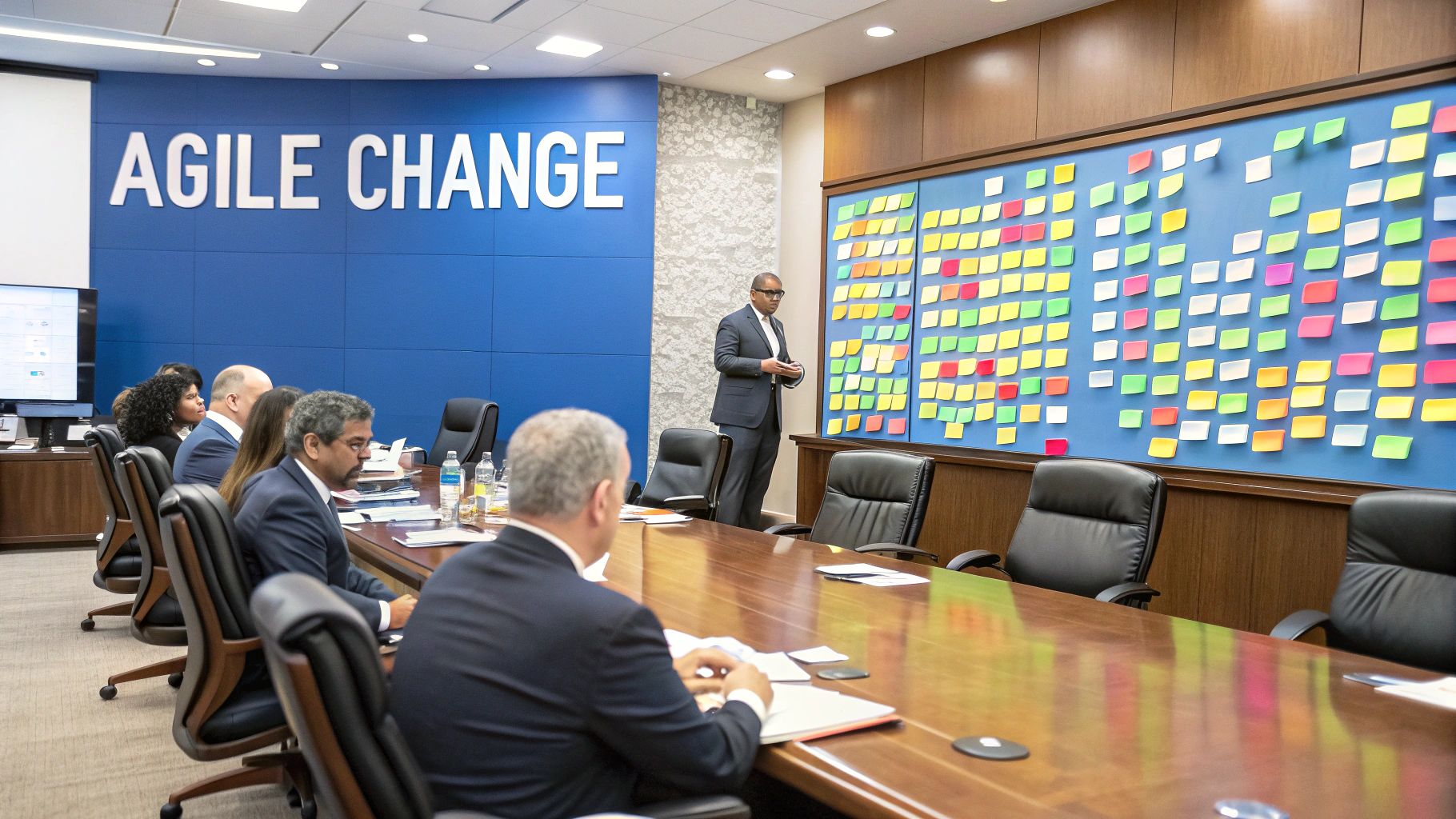
Several key factors contribute to this cultural inertia. These include resistance to self-organization, especially from middle management who might perceive a loss of control. There can also be conflict between traditional performance metrics and Agile values. Finally, shifting away from established hierarchical decision-making is inherently difficult. For instance, traditional performance reviews typically focus on individual contributions, whereas Agile emphasizes team accomplishments.
This challenge is critical because, if left unaddressed, cultural resistance can completely derail Agile initiatives. It demands substantial time and leadership commitment. In extreme cases, it might even necessitate difficult personnel changes. However, early identification of this resistance allows for focused change management strategies. Addressing these cultural obstacles offers a valuable opportunity for organizational growth and leads to more sustainable Agile adoption.
Examples of Successful Agile Transformations
Many successful Agile transformations have prioritized overcoming cultural resistance. Spotify’s model, with its squads, tribes, chapters, and guilds, offers a compelling example of restructuring organizational hierarchies to support Agile principles. Microsoft’s shift from waterfall to Agile processes under Satya Nadella demonstrates the impact of top-down leadership in driving cultural change. IBM’s large-scale enterprise Agile transformation further highlights the potential for even large, complex organizations to adopt Agile.
Practical Tips for Navigating Cultural Resistance
-
Start with Executive Buy-In and Education: Secure support from leadership to champion the change and provide the necessary resources.
-
Focus on Benefits, Not Methodology: Emphasize the value Agile brings, such as faster time to market and higher customer satisfaction, rather than technical details.
-
Empower Internal Champions: Identify and empower individuals across departments who can act as change agents and advocate for Agile principles within their teams.
-
Create a Safe Environment for Experimentation: Encourage teams to explore new approaches without fear of failure, fostering a culture of continuous improvement.
-
Celebrate Early Wins: Highlighting successes builds momentum and reinforces the positive impact of Agile.
The crucial role of cultural change in Agile adoption has been highlighted by figures like John Kotter, a renowned change management expert, and Jurgen Appelo, a proponent of Management 3.0 principles. The Agile Manifesto itself underscores the importance of individuals and interactions over processes and tools. You might also find our guide on the latest software development trends helpful: Our guide on latest software development trends. By understanding the dynamics of cultural resistance and proactively applying these strategies, organizations can create a path toward successful and lasting Agile transformation.
Scaling Agile Across Large Organizations

Agile methodologies are known for their effectiveness in small, co-located teams. However, the benefits of Agile are highly desirable across entire enterprises. This presents a challenge: how to scale these practices across larger, often distributed organizations. These organizations typically have multiple teams, interconnected products, and complex dependencies.
This challenge is significant because effectively scaling Agile is essential for large organizations to stay competitive and adapt to market changes. If this challenge isn’t addressed, organizations risk fragmented efforts, inconsistent practices, and a diminished realization of Agile’s potential benefits.
What is Scaling Agile?
Scaling Agile involves adapting Agile principles and practices to function effectively in larger, more complex settings. It’s about coordinating multiple Agile teams working on related products. It also means aligning their sprint cycles and release schedules while maintaining consistent Agile practices across different teams.
Key features addressed by scaling frameworks include:
- Coordination of multiple teams: This involves establishing clear communication channels and processes for managing dependencies between teams working on related products or features.
- Alignment of sprint cycles and release schedules: Synchronizing sprints and releases ensures a smooth, efficient flow of value delivery across the organization.
- Consistent practices: Standardizing Agile practices across teams helps create predictability and a shared understanding, while still allowing individual teams a degree of autonomy.
- Managing dependencies: Effectively identifying and managing dependencies between teams and systems minimizes bottlenecks and prevents project delays.
Pros and Cons of Scaling Agile
Successfully scaling Agile can lead to enterprise-wide agility and responsiveness. This creates organizational alignment around value delivery and enables coordinated innovation across multiple product lines. But, it also presents challenges:
| Pros | Cons |
|---|---|
| Enterprise-wide agility and responsiveness | Significant investment in frameworks and tooling |
| Organizational alignment around value delivery | Potential overhead and complexity, which can contradict Agile principles |
| Coordinated innovation across multiple products | Resistance from teams already succeeding with local Agile practices |
Agile Scaling Frameworks
The need to scale Agile led to the development of several frameworks and methodologies. Dean Leffingwell popularized the Scaled Agile Framework (SAFe), while Craig Larman and Bas Vodde introduced LeSS (Large-Scale Scrum). Scrum creators Jeff Sutherland and Ken Schwaber also developed Scrum@Scale.
Here are some examples of these frameworks in action:
- Ericsson: Implemented SAFe with over 20,000 developers to enhance coordination and delivery efficiency in large-scale software development projects.
- LEGO: Adapted existing scaling models to meet their unique organizational needs, highlighting the importance of tailoring frameworks to specific contexts.
- Bosch: Utilized LeSS for both hardware and software development, showcasing the framework’s versatility.
Practical Tips for Scaling Agile
Implementing scaled Agile requires careful planning and execution. Consider these tips:
- Pilot program: Start small with a pilot program to test the suitability of a framework and identify potential issues before a full-scale rollout.
- Contextual adaptation: Adapt the chosen framework to your specific organizational context and structure. Avoid rigid adoption.
- Automation: Invest in automation for integration, testing, and deployment to streamline processes and reduce manual overhead.
- Communities of practice: Establish communities of practice to encourage knowledge sharing and the spread of best practices among teams.
- Dependency management: Implement clear processes for managing dependencies between teams and systems.
By addressing the complexities of scaling Agile, organizations can unlock the full potential of Agile principles. This can lead to significant improvements in value delivery, responsiveness to change, and the ability to innovate at scale.
Technical Debt Management

In the world of Agile development, teams are constantly under pressure to deliver new features quickly. This often leads to technical debt: shortcuts, workarounds, and less-than-ideal design choices made to speed up the development process.
While these choices may provide short-term gains, they can have a significant negative impact on a project’s long-term health. Maintainability, scalability, and overall success can suffer, making technical debt a major challenge in Agile development.
What is Technical Debt?
The term “technical debt,” coined by Ward Cunningham, describes these development shortcuts. The metaphor compares these shortcuts to financial debt. Just as accumulating financial debt incurs interest payments, technical debt incurs interest in the form of increased complexity and reduced development speed. This can even lead to a higher risk of bugs.
This “interest” can manifest in several ways:
- Reduced Code Quality: Choosing a faster, less elegant solution now often means rework later.
- Difficult Maintenance: A codebase filled with technical debt is harder to understand and modify.
- Slower Feature Development: Adding new features becomes more complex and error-prone.
- System Instability: Technical debt can lead to unexpected behavior and an increase in bugs.
Strategic Debt vs. Unmanaged Debt
Technical debt isn’t always bad. Strategic technical debt, consciously taken on to achieve a business goal (like a faster product launch), can be beneficial. The key is to acknowledge it, manage it, and have a plan to address it.
Managing Technical Debt - The Pros:
- Cost Transparency: Understanding the impact of technical debt helps teams prioritize its repayment.
- Faster Initial Delivery: Strategic debt can be a calculated risk to gain early market advantage.
- Long-Term Productivity Gains: Addressing debt improves code quality, making future development smoother.
Unmanaged Technical Debt - The Cons:
- Stakeholder Buy-in: Justifying debt repayment to non-technical stakeholders can be difficult.
- Measurement Challenges: Quantifying the impact of technical debt can be complex.
- Crisis Potential: Ignoring technical debt can lead to major problems down the line.
Real-World Examples of Managing Technical Debt
Many leading tech companies have implemented strategies to manage technical debt:
- Etsy: Etsy dedicates “engineering weeks” focused on technical improvements and debt reduction.
- Google: Google’s “20% time” allows engineers to work on personal projects, often including addressing technical debt.
- LinkedIn: LinkedIn’s “Tax Day” encourages teams to focus on fixing bugs and reducing technical debt.
Practical Tips For Managing Technical Debt
- Track Metrics: Monitor code complexity, duplication, and bug density.
- Dedicated Time: Schedule refactoring sprints or allocate time in each sprint for debt reduction.
- Educate Stakeholders: Explain the business impact of technical debt to gain support.
- Code Quality Gates: Implement automated checks in your CI/CD pipeline to enforce code quality standards.
- Document Decisions: Record the reasons for incurring technical debt and create repayment plans.
Influential figures like Ward Cunningham, Martin Fowler (a proponent of refactoring), and Robert C. Martin (known for his Clean Code principles) have helped the software development community understand and address technical debt. By proactively managing technical debt, Agile teams can ensure long-term project success, maintain a sustainable development pace, and deliver high-quality software.
Stakeholder Engagement and Alignment
Agile development thrives on collaboration. Effective stakeholder engagement is a crucial piece of this puzzle. This involves ensuring continuous, active participation from business stakeholders throughout the development process. They provide feedback, validate the direction, and make key decisions. Without this engagement, Agile projects often face misalignment, delayed decision-making, and ultimately, products that don’t meet their goals. This challenge deserves attention because it directly impacts the value and success of any Agile initiative.
The Need for Shared Understanding
Agile’s iterative nature requires frequent, meaningful feedback. Gathering this feedback from stakeholders can be a significant hurdle due to competing priorities and limited availability. Shifting requirements and expectations can further complicate alignment. Success depends on establishing a shared understanding of the product vision and maintaining open communication channels.
Benefits of Strong Stakeholder Alignment
- More Valuable Products: Active stakeholder participation increases the likelihood of a product meeting market needs and delivering real business value.
- Reduced Late-Stage Changes: Regular engagement helps identify and address potential issues early, minimizing costly and time-consuming changes later.
- Improved Satisfaction: Shared ownership fosters collaboration and increases stakeholder satisfaction with the final product.
Challenges in Stakeholder Engagement
- Time Constraints: Stakeholders, especially senior leaders, often have limited time.
- Conflicting Priorities: Multiple stakeholders may have differing, even conflicting, priorities.
- Resistance to Incremental Validation: Some stakeholders struggle with Agile’s iterative nature and incremental validation.
Real-World Examples of Successful Stakeholder Engagement
- USAA’s “Design Studios”: USAA uses “design studios” – collaborative workshops bringing stakeholders and developers together – to co-create solutions and ensure early alignment.
- Nordstrom’s Innovation Lab: Nordstrom’s innovation lab embeds developers in retail stores alongside stakeholders, facilitating direct observation of customer behavior and real-time feedback.
- UK Government Digital Service (GDS): GDS emphasizes continuous user research and stakeholder involvement, ensuring services are designed and iterated based on real user feedback.
Practical Tips for Effective Stakeholder Engagement
- Dedicated Product Owner: Identify and onboard a dedicated product owner with clear decision-making authority to represent stakeholder interests.
- Structured Engagement Model: Create a structured engagement model with defined roles, responsibilities, and communication channels.
- Visualization Techniques: Use visualization techniques, like user story mapping and Kanban boards, to make progress and decisions transparent.
- Regular Demos: Establish regular product demonstrations for stakeholders to provide feedback and validation.
- Asynchronous Feedback: Use asynchronous feedback mechanisms, such as online surveys and collaborative platforms.
Evolution and Popularization
The importance of stakeholder engagement has been emphasized by key figures in the Agile community. Jeff Patton’s work on User Story Mapping provides a powerful visual framework for collaborating with stakeholders. Roman Pichler’s contributions to the product owner role have clarified responsibilities and emphasized stakeholder communication. Marty Cagan’s work on product management in Agile highlights the critical role of stakeholders in driving product success. Their combined influence has made stakeholder engagement a core tenet of Agile development.
Remote and Distributed Team Collaboration

Agile methodologies, initially designed for teams working in the same location, emphasized close collaboration and face-to-face communication. However, the way we work has changed. Distributed and remote teams are now the norm, creating new challenges for Agile practices across different time zones and geographical locations. This makes remote team collaboration a key hurdle in Agile development.
The shift to remote work has been a gradual process, driven by advances in communication technology and accelerated by events like the COVID-19 pandemic. Companies like GitLab, a fully remote company with over 1,300 employees in 65+ countries, demonstrate that large-scale distributed Agile can be highly successful. Trello, known for its project management software, uses its own tools internally for managing remote Agile practices. Automattic, the company behind WordPress, also thrives on a distributed team model, occasionally supplemented by in-person gatherings. These examples highlight the growing adoption of distributed Agile.
Features and Challenges
Several factors contribute to the complexity of remote and distributed Agile:
-
Communication Barriers Across Time Zones: Coordinating meetings and maintaining smooth information flow is harder with team members spread across different time zones.
-
Difficulty in Facilitating Effective Remote Ceremonies: Agile ceremonies like daily stand-ups, sprint reviews, and retrospectives require careful planning and facilitation in remote settings to ensure everyone participates and contributes effectively.
-
Challenges in Building Team Cohesion Without Physical Presence: Building trust and strong relationships within a team can be more challenging without regular in-person interaction.
-
Limitations in Spontaneous Collaboration and Problem-Solving: The quick problem-solving discussions and impromptu whiteboard sessions common in co-located teams require more effort and specialized tools to replicate remotely.
Pros and Cons
Distributed Agile presents both challenges and advantages:
Pros:
-
Access to Global Talent Pools: Searching for talent beyond geographical boundaries allows you to access a broader range of skills and experience.
-
Forces Better Documentation and Communication Practices: The need for clear, asynchronous communication in remote environments encourages better documentation.
-
Can Lead to More Asynchronous and Efficient Workflows: Distributed teams often use asynchronous communication, leading to more focused work and greater individual productivity.
Cons:
-
Higher Risk of Miscommunication and Misalignment: Without face-to-face interaction, there’s a greater chance of misunderstandings.
-
More Difficult to Build Team Trust and Psychological Safety: Creating a sense of psychological safety and rapport requires more deliberate effort in remote teams.
-
Technical Collaboration Challenges: Tasks like pair programming and collaborative debugging can be more complex in remote settings.
Tips for Implementing Distributed Agile
-
Invest in Proper Collaboration Tools: Use video conferencing, instant messaging, digital whiteboards (e.g., Miro, Mural), and project management software to support communication and collaboration.
-
Establish Clear Communication Protocols and Working Agreements: Set clear expectations for communication frequency, response times, and meeting etiquette.
-
Create Overlapping Working Hours for Synchronous Collaboration: Establish some overlapping working hours for real-time meetings and discussions.
-
Use Visual Management Tools Accessible to All Team Members: Use online Kanban boards, sprint backlogs, and other visual tools to ensure transparency and keep the team aligned.
-
Schedule Periodic In-Person or Virtual Team-Building Events: Organize regular social activities, both virtual and in-person (if possible), to strengthen team bonds and build relationships.
The work of individuals like Lisette Sutherland (Work Together Anywhere), Jason Fried and David Heinemeier Hansson (authors of Remote: Office Not Required), and Matt Mullenweg (Automattic’s distributed work model) has greatly influenced and popularized best practices for remote work and distributed Agile. By understanding the challenges and implementing these strategies, organizations can harness the benefits of distributed Agile and build successful remote teams.
Requirements Management and Prioritization in Agile Development
Managing and prioritizing requirements in agile development is a continuous balancing act. Agile’s core principle is embracing change. This adaptability, while a strength, can make capturing, refining, and prioritizing requirements difficult as business needs change throughout development. This is why effective requirements management is a key challenge in agile.
One core aspect of this challenge is the evolving nature of requirements. Teams often struggle to balance creating detailed initial specifications with remaining flexible as the project progresses. Breaking down complex requirements into smaller, manageable pieces can also be difficult, especially with complex systems or new technologies.
Balancing short-term needs with the long-term product vision adds another layer of complexity. Managing competing priorities from different stakeholders can be a significant hurdle, requiring careful negotiation and alignment.
Benefits of Effective Requirements Management
Mastering requirements management and prioritization offers significant advantages. Effective management streamlines development, boosting efficiency and reducing wasted effort. Good prioritization ensures the highest-value features are developed and released first.
Proper backlog refinement, a critical aspect of agile, minimizes waste and rework by focusing the team’s efforts.
Potential Downsides and Risks
If not managed carefully, changing requirements can lead to scope creep, impacting timelines and budgets. Maintaining consistency with shifting priorities can also be challenging and requires diligent communication and documentation. Finding the right balance between sufficient and excessive documentation is an ongoing challenge for many agile teams.
Real-World Examples of Effective Requirements Management
Several successful companies demonstrate effective strategies. Intercom uses the “Jobs to be Done” framework to define requirements based on customer needs. Netflix employs a “consumer science” approach using A/B testing and data analysis to validate requirements and guide feature development. Basecamp uses the “Shape Up” method, a fixed-time, shaped scope approach, concentrating on delivering complete, valuable features within a set timeframe.
Practical Tips for Improvement
- User Story Mapping: This technique helps visualize the user journey, simplifying feature prioritization for value delivery. Story mapping provides a collaborative framework for product development.
- Prioritization Frameworks: Use frameworks like RICE (Reach, Impact, Confidence, Effort), WSJF (Weighted Shortest Job First), or MoSCoW (Must have, Should have, Could have, Won’t have) to create a transparent prioritization process. Don Reinertsen’s work provides valuable insights into WSJF.
- Regular Backlog Refinement: Frequent sessions with cross-functional teams ensure clarity, identify dependencies, and estimate effort.
- Definition of Ready: Establish clear criteria for requirements before development begins. This prevents ambiguity and ensures the team has the necessary information.
- Vertical Slicing: Deliver end-to-end value in each iteration by developing features in vertical slices that cut across all application layers. This allows for rapid feedback and value validation.
The concept of user stories, popularized by Mike Cohn, has greatly influenced how agile teams capture and manage requirements. This approach focuses on the user’s perspective and the value each feature provides.
By understanding these challenges and applying these practical tips, agile teams can effectively manage and prioritize requirements, maximizing value for their customers while embracing the flexibility of agile development.
Quality Assurance and Testing in Agile Development
Integrating thorough testing within the fast-paced Agile environment presents a significant challenge. Balancing the need for rapid software delivery with ensuring high quality, especially for complex systems requiring extensive regression or specialized testing, is a key concern for Agile teams.
This time constraint on testing requires a shift from traditional QA approaches. Teams must balance testing thoroughness with speed, integrating quality practices throughout the development lifecycle. This often means adopting new tools and strategies like automation, which is crucial for supporting rapid release cycles as manual testing alone can’t keep pace with Agile’s demands.
Benefits of QA Integration
Successfully integrating QA offers substantial benefits. Early defect detection through continuous testing reduces costs and rework. Faster feedback loops allow for quicker adjustments and improvements, creating a more responsive development cycle. Test automation supports a sustainable delivery pace, minimizing QA team burnout.
Challenges of QA Integration
However, integration isn’t without its hurdles. It requires investment in testing infrastructure, including automation tools like Selenium, training, and potentially specialized hardware. Maintaining comprehensive test coverage becomes challenging with the rapid changes inherent in Agile. Integrating specialized testing, such as security and performance testing, into short sprints can also be difficult.
Real-World Examples
Real-world examples showcase successful Agile testing approaches. Google’s continuous testing uses automation at scale, enabling rapid feedback and deployment. Spotify employs testing in production with feature toggles, allowing real-time testing with minimal user impact. Etsy’s automated testing and one-click deployment streamline releases while maintaining quality. For a broader view, check out this article: Elevating Quality Assurance Beyond Testing to Ensure Superior Software Delivery.
Practical Tips for Agile Testing
To effectively integrate QA and testing into your Agile workflow:
- Test-Driven Development (TDD): Write tests before code, ensuring code meets requirements from the start.
- Continuous Integration/Continuous Deployment (CI/CD): Automate the build, test, and deployment process using tools like Jenkins for faster feedback and releases.
- Behavior-Driven Development (BDD): Align tests with business value using a common language understood by developers and stakeholders, often facilitated by tools like Cucumber.
- Testing Quadrants: Ensure balanced test coverage by categorizing tests based on purpose (supporting the team, critiquing the product).
- Integrated Teams: Foster collaboration by integrating testers into development teams, avoiding siloed testing phases.
Influential Figures in Agile Testing
These concepts are championed by influential figures. Lisa Crispin and Janet Gregory’s work on Agile Testing, Kent Beck’s advocacy of Test-Driven Development, and Gojko Adzic’s contributions to Specification by Example have significantly shaped Agile testing approaches. By understanding and applying these principles, teams can effectively integrate QA and testing into Agile workflows, delivering high-quality software efficiently.
Contracts and Compliance in Agile Projects
Agile development, with its iterative nature and emphasis on adapting to change, often presents challenges when integrating traditional contracting and compliance requirements. This makes navigating these areas a key hurdle in Agile projects. Organizations used to fixed-scope contracts, waterfall-based governance, and detailed upfront documentation often struggle to reconcile these practices with Agile’s flexible approach.
Traditional fixed-scope contracts often contradict Agile’s core principle of embracing change. Regulatory environments, particularly in industries like healthcare and finance, frequently require extensive documentation, which can feel cumbersome in Agile’s fast-paced iterations. Likewise, governance processes designed for waterfall methodologies often don’t align with Agile’s decentralized decision-making. Procurement processes, accustomed to detailed upfront specifications, can find it difficult to adapt to Agile’s evolving requirements. These represent significant friction points.
Successfully integrating compliance within Agile, however, offers considerable benefits. It allows regulated industries to leverage Agile’s advantages, resulting in faster time-to-market and improved product quality. Innovative contract structures, such as time and materials or target price contracts, can better align vendor and client incentives, fostering collaboration. A clear compliance integration strategy reduces project risks by ensuring regulatory requirements are met throughout the development lifecycle.
However, implementing compliance in Agile also has its drawbacks. It can introduce overhead to Agile processes, requiring dedicated resources and potentially slowing down iterations. Educating legal and compliance stakeholders on Agile principles and benefits is often a significant task. Some organizations adopt hybrid approaches, blending Agile and waterfall methodologies, which can compromise the full benefits of Agile.
Real-World Examples of Agile Compliance
- UK Government Digital Service (GDS): The GDS has championed the use of Agile contracts in the public sector, demonstrating that Agile can be effective even in highly regulated environments.
- Target: This retail giant has implemented “Agile contracts” with external vendors, showcasing the adaptability of Agile procurement processes.
- FDA’s Recognition of Agile: The Food and Drug Administration’s increasing acceptance of Agile in medical device development signals a shift towards embracing Agile in highly regulated industries.
Agile contracting has been influenced by thought leaders like Susan Atkinson and Gabrielle Benefield, who developed influential models for Agile contracts. Tom Arbogast has promoted the use of Agile in regulated environments, and Alistair Cockburn has provided insights into integrating compliance within Agile.
Practical Tips for Agile Compliance
- Time and Materials Contracts: Use time and materials contracts with regular evaluation points. This provides flexibility while maintaining control over spending.
- Target Price Contracts: Implement ‘target price’ contracts with shared risk/reward. This incentivizes collaboration between client and vendor.
- Definition of Done: Integrate compliance requirements into the ‘definition of done’. This ensures compliance is considered at every stage.
- Incremental Documentation: Develop documentation incrementally alongside working software. This avoids a last-minute documentation rush.
- Stakeholder Education: Educate procurement and legal teams on Agile principles and benefits. This fosters understanding and buy-in.
By understanding the challenges and applying these tips, organizations can navigate the complexities of contracts and compliance in Agile projects, gaining the benefits of Agile while adhering to regulatory requirements.
Agile Development: 8-Point Challenge Comparison
| Title | 🔄 Complexity | ⚡ Resources | 📊 Outcomes | ⭐ Advantages |
|---|---|---|---|---|
| Organizational Culture Resistance | High due to entrenched hierarchies and resistance to change | Significant leadership commitment and change management efforts | Sustainable Agile adoption and gradual cultural renewal | Early identification mitigates long-term barriers |
| Scaling Agile Across Large Organizations | High complexity coordinating multiple teams and dependencies | Investment in frameworks, tooling, and training | Enterprise-wide agility and aligned delivery | Unified value delivery and coordinated innovation |
| Technical Debt Management | Moderate balancing speed with increasing system complexity | Dedicated refactoring time and tracking mechanisms | Improved long-term productivity and maintainable codebases | Visibility into hidden costs and sustainable code quality |
| Stakeholder Engagement and Alignment | Moderate due to conflicting priorities and limited stakeholder time | Structured engagement processes and dedicated product owners | Better product alignment with early feedback | Enhanced decision-making with shared ownership |
| Remote and Distributed Team Collaboration | Moderate-high because of communication and time zone challenges | Investment in robust digital collaboration tools and protocols | Access to global talent resulting in efficient asynchronous work | Broader talent access with improved documentation and communication |
| Requirements Management and Prioritization | Moderate with evolving requirements and shifting business needs | Use of clear prioritization frameworks and regular backlog refinement | Increased development efficiency and focused business value | Streamlined backlog and minimized scope creep |
| Quality Assurance and Testing Integration | High with compressed testing cycles and complex systems | Significant investment in automation and CI/CD pipelines | Faster feedback loops and reduced defect rework | Early defect detection and continuous quality validation |
| Contracts and Compliance in Agile Projects | High complexity reconciling fixed contracts and regulatory requirements | Extensive effort from legal, compliance, and procurement teams | Regulated Agile delivery with reduced project risks | Innovative contract structures aligning vendor and client incentives |
Level Up Your Agile Practices
Successfully navigating the Agile world requires a deep understanding of its core principles and a proactive approach to common challenges. From cultivating a collaborative company culture to managing technical debt, each element contributes to true agility. Effectively scaling Agile across larger organizations, mastering remote team collaboration, and seamlessly integrating quality assurance are equally crucial. Finally, maintaining focus on requirements management and understanding contracts and compliance within Agile projects are key to delivering successful results.
Putting these concepts into practice means building cross-functional teams, empowering individuals, and establishing continuous feedback loops. Embrace iterative development, prioritize customer value, and remain flexible to adapt to evolving requirements. Learning and adaptation are cornerstones of Agile. Regularly assess your processes, identify areas for improvement, and encourage experimentation to refine your approach.
Future Trends in Agile
Looking ahead, trends like AI-powered automation, a growing emphasis on security, and the rise of value stream management are shaping the future of Agile. Staying informed about these developments and incorporating relevant practices will be essential for maintaining a competitive edge. For those interested in learning more about value stream management, check out resources from the Value Stream Management Consortium.
Key Takeaways From Agile Development
- Culture is Key: Foster a supportive environment that values change and collaboration.
- Smart Scaling: Implement strategies for effectively scaling Agile across larger organizations.
- Technical Debt Management: Prioritize addressing technical debt to maintain long-term velocity.
- Stakeholder Engagement: Ensure clear communication and alignment with all stakeholders.
- Effective Collaboration: Facilitate effective collaboration, especially in remote and distributed teams.
- Requirements Prioritization: Establish clear processes for managing and prioritizing requirements.
- Quality Integration: Embed quality assurance throughout the development lifecycle.
- Contract Navigation: Understand how to manage contracts and compliance within an Agile framework.
Ensuring Application Stability and Reliability
Ready to elevate your Agile development and ensure the stability and reliability of your applications? GoReplay, an open-source tool for capturing and replaying live HTTP traffic, helps transform real production traffic into a powerful testing asset. Detect and resolve issues before they impact your users by mirroring real user interactions in your testing environments. From load testing and simulating real-world traffic scenarios to monitoring user behavior in real-time, GoReplay offers a comprehensive solution for robust testing. Explore the power of GoReplay and experience confident deployments.